Showing posts with label Nitish Kumar. Show all posts

Thursday, March 10, 2022

Huge loss for Congress in Rajya Sabha

by Harish Gupta, National Editor, Lokmat Group
The hopes of many congress leaders to get a Rajya Sabha seat from Punjab have been dashed to the ground with the AAP sweeping the Assembly polls. Even the BJP and Akali Dal together cannot claim a single Rajya Sabha from the state. The AAP will have a bonanza of winning at least four out of five Rajya Sabha seats.

Be it Shamsher Singh Dullo or Pratap Singh Bajwa,both will retire on April 2 from the Rajya Sabha and are unlikely to return in future. Since the Rajya Sabha polls for three seats will be held first, each candidate will require 40 votes. The AAP will win at least two seats in the first round of Rajya Sabha polls. The third seat could go to the Opposition parties if Congress, Akali Dal and BJP and others could come together. Otherwise, the third seat will also go to the AAP.

Then the biennial poll for two seats will be held where 117 MLAs will elect them. Naresh Gujral (Akali Dal ) and Shwait Malik (BJP) will also retire from the Rajya Sabha. It is ironic that a new party like AAP will send another batch of 4-5 Rajya Sabha MPs in Parliament. The mandate of Punjab is such that AAP will sweep the Rajya Sabha polls and Congress strength in the Rajya Sabha will dwindle from 34 to 31. It is also losing a seat in Himachal Pradesh (Anand Sharma) and one in Assam.

It is a huge setback to Congress and Akali Dal.
Maharashtra’s Jaiswal new RAW Chief!
Maharashtra’s senior IPS officer of the 1985 batch Subodh Kumar Jaiswal seems to be a lucky man. Jaiswal was having a running battle with former Maharashtra Home Minister Anil Deshmukh and looking for a way out. But he was not the first choice for the post of the CBI Director of the Prime Minister either when a short-list was prepared. The first choice was CBI's Special Director Rakesh Asthana, a Gujarat cadre officer and Modi's hot favourite. As luck would have it, Chief Justice of India, N V Ramana was against Asthana and consensus emerged in favour of Jaiswal during the selection committee meeting. Now the Prime Minister’s Office is very happy with Jaiswal and he has emerged as a favourite and trusted IPS officer in the government. It transpires that Jaiswal may soon be rewarded with another top job. If sources in the PMO are to be believed, Jaiswal may be sent to India’s premier espionage agency, Research & Analysis Wing (RAW). The current RAW Chief Samant Goel’s tenure is ending in June this year. But Jaiswal may be sent there in early April to RAW and Samant Goel may be appointed to another coveted post for the next couple of years. Jaiswal may also be happy in RAW as its chief for next two year. His tenure in CBI ends early next year and get a reward of one extra year. It may also be mentioned here that Jaiswal has been in RAW earlier and earned laurels.

Praveen Sinha may be next CBI Chief
Reward to Jaiswal is not without a reason. The government is keen to make Praveen Sinha as the next CBI Director. Sinha is currently number-two as Special Director. He is a 1988 batch IPS officer of Gujarat cadre and due to retire in April this year. If he is not made CBI Director before April, he cannot become a regular Director. When Subodh Kumar Jaiswal was chosen as the CBI Director last year, Sinha was not eligible for consideration for the post as officers belonging to batches between 1984 to 1987 were considered. If the post of the CBI Director falls vacant now, he can emerge as a strong contender for the top job. In any case, he can be given the charge of a Director without delay if Jaiswal quits before tenure and goes to RAW. Another reason in Sinha's favour is that he was elected to the Interpol's Executive Committee from Asia after a bitterly fought election last year defeating China. The entire might of the PMO and Ministry of External Affairs was put to ensure Sinha’s victory. This crucial post is for three-year and if Sinha is allowed to retire, India cannot retain this post at the Interpol. Therefore, in order to retain this post, Sinha is to be retained as no retired officer can be in the Executive Committee of Interpol as per rules. It is in this context that Praveen Sinha may have to be given the coveted post and Jaiswal being shifted to RAW. But there are many slips between the cup and lip.

Baffling reshuffle in PMO
The PMO is witnessing some interesting reshuffle and bureaucrats are keeping their fingers crossed. First, it was Senior Adviser Amarajeet Sinha in the PMO who quit his job all of a sudden seven months before his tenure in August 2021.Prior to him P K Sinha, Principal Adviser in the PMO, quit last year. Sinha was Cabinet Secretary prior to joining the PMO. It was rumoured that he may be brought in as LG of Delhi. But it's been over a year and he is cooling his heels. Now Bhaskar Kulbe who was appointed as Adviser to the Prime Minister, has put in his papers. Kulbe was earlier, secretary in the PMO and allowed to retire. After a couple of months, he was appointed as Adviser to the PM in 2020. But all of a sudden, he too put in his papers and quit. Interestingly, no replacements have been brought in the PMO after three senior officers quit in less than a year. The Principal Secretary to the PM, P K Mishra is reported to be in favour of cutting manpower in the government and beginning has been made in the PMO itself. It is authoritatively learnt that National Security Adviser Ajit Doval recently expressed his desire to resign considering his age. Doval is 77 years old and wants to be relieved. But the Prime Minister is reported to have declined to accept his resignation. Earlier, Nripendra Mishra, Principal Secretary to the PM, also quit a few months after he was re-appointed to the coveted post after Modi's big win in 2019 Lok Sabha polls.

Clouds over Gehlot, Baghel, No way
Having lost power in Punjab rather badly, the leaders in two Congress-ruled states – Rajasthan and Chhattisgarh are waiting with bated breath for the high command to focus on restructuring the party and even change of guards. A decision will have to be taken on the new party president in these two states. While Sachin Pilot loyalists hope there will be a leadership change in Rajasthan, in Chhattisgarh, a group led by TS Singh Deo, the current health minister, is hoping for something similar. The incumbent Chhattisgarh chief minister, Bhupesh Baghel, is extremely close to Rahul Gandhi and Priyanka Gandhi Vadra, and has played key roles in recent assembly elections in Assam and Uttar Pradesh. Therefore, there is no possibility of a leadership change. In the case of Rajasthan CM, Ashok Gehlot, the high command has committed that the next Assembly polls will be fought under his leadership. It means that his loyalists will be accommodated in the government. It is however, not certain what Pilot wants after the results of Assembly polls are out.

No Takers of Nitish Kumar
Bihar Chief Minister Nitish Kumar is an extremely worried man. Ever since BJP emerged as number one party in 2020 Assembly polls forcing Janata Dal (U) to play a second fiddle, the “Sushashan Babu” has been desperately trying to find a way out. The day is not far when the BJP will split other parties in Bihar and form its own government in the event of winning the UP Assembly polls. It was in this background that Nitish Kumar's name suddenly made headlines as the possible Presidential candidate for the July 2022 polls. It emerged that freelance poll strategist Prashant Kishore was behind it. This news was spread after Telangana CM K Chandrashekhar Rao and Maharashtra CM Uddhav Thackeray met for nearly four hours in Mumbai. When asked, Shiv Sena leader Sanjay Raut denied saying there was no discussion on the presidential poll during the four hour long meeting as Raut was present throughout. It is Kishore who wants Nitish Kumar to move to the national scene to fill the vacuum among the non-BJP forces. But there are no takers of Nitish Kumar in the Opposition camp as his political integrity has taken a big hit.

Sunday, April 11, 2021

Fly On the Wall | Why Pawar, Nitish missing in Action

by Harish Gupta, National Editor, Lokmat Group

Why Pawar, Nitish missing in Action
Sharad Pawar had declared with a big fanfare to lend NCP’s support to the Trinamool Congress headed by Chief Minister Mamata Banerjee. The Maratha strongman had also declared that he would campaign for the TMC candidates in West Bengal. The Congress was peeved at Pawar’s decision to support Mamata as NCP is sharing power in Maharashtra. The NCP supremo is also desirous to play a more active role in the UPA at the national level too. Realizing the sensitivities involved, NCP explained that Mamata Banerjee is close to the “Saheb” and the latter will only address a couple of rallies as a symbol of support. But Pawar could not make it in March as he was busy in resolving the crisis that erupted after Wazegate culminating in the resignation of Home Minister Anil Deshmukh. Later, Pawar developed severe abdomen pain leading to his admission at a private hospital. He was advised complete rest before he could be operated upon as his parameters were not fit to be operated upon. He cannot campaign anymore and there is no prospect of his being in action in West Bengal in near future either.

Nitish, Tejashwi keep away too
Sharad Pawar is not alone missing in action. Bihar Chief Minister Nitish Kumar and RJD leader Tejashwi Yadav are also keeping completely away in this round of Assembly polls. Though the Janata Dal (United) is contesting the West Bengal polls dumping its alliance partner BJP, Kumar has chosen to keep away and not campaign. On the other hand, the RJD is supporting the TMC despite being a partner of Congress in Bihar. But Tejashwi is also looking the other way and has not for campaigning. The JD (U) doesn’t explain why it has left its candidates in the lurch in West Bengal. However, a close confidante of Nitish Kumar said he is avoiding traveling West Bengal to keep the BJP and Mamta Banerjee in good humour. Mamata has a fractured leg and Nitish Kumar doesn’t want to rub salt on her wounds in the given situation. After all, Nitish Kumar has also been nursing national ambitions like Sharad Pawar. The Congress is also confused as it is hand-in-glove with the Left in West Bengal while fighting with the CPM in Kerala. Secondly, Rahul Gandhi has not rolled out his program to campaign in West Bengal so far either.

Priyanka goes missing too!!
Priyanka Gandhi Vadra has gone into self quarantine after her husband Robert Vadra tested positive of Covid almost a week ago. The jolt came when she was drawing huge crowds during her rallies in Kerala. According to Congress insiders, she was able to connect better with the voters due to her style of campaigning causing some anxiety in some party quarters. Though Priyanka has now been tested negative, she continues to stay home. Whatever may be the reasons; her absence is a setback to the party as most of the party’s 30 star campaigners were missing in action including Capt Amrinder Singh, Navjot Singh Sidhu to name a few. Even Rahul Gandhi has been missing in action in West Bengal, at least until writing this column. Perhaps, it’s a season of leaders missing in action.

Missing frontline workers for Jab
The Prime Minister’s Task Force on Vaccination is burning midnight oil as Health and Frontline Workers (HFW) are missing in getting themselves vaccinated. Of the 3 crores HFWs only 65% came forward for the first vaccine dose during the past 90 days while 50% came for the second dose. The government is worried about these missing Covid warriors and vaccine hesitancy has clearly among them. It is worrisome as they are directly dealing with the deadly disease. The government toyed with the idea of imposing certain restrictions on those refusing to take the jab as suggested by experts and Indian Medical Association too. But these are tough times and the government cannot risk taking disciplinary action against them for refusing to take the jab. Dr Randeep Guleria, Director AIIMS and member of the PM’s Task Force, has been on record to say that this hesitancy may be because they want to wait and read more. He did not elaborate but many are worried as the government is not sharing the Adverse Events Following Immunization (AEFI) data. Though the government told Parliament that 89 adverse events took place and none of them was due to vaccination. But it has not shared the causes behind such deaths so far except in 13 cases.

Sunday, September 27, 2020

Fadnavis flying to Patna, Delhi for talks

  • BJP not to buckle under Nitish Pressure
  • Wants JD(U) to contest 102 seats only
Harish Gupta, National Editor, Lokmat Group
New Delhi, Sep 26

Former Maharashtra Chief Minister and incharge of BJP’s Bihar unit Devendra Fadnavis will be flying to Patna and later Delhi to finalise party’s strategy for October 28 Assembly polls.

If sources close to Fadnavis are to be believed, the party is unlikely to buckle under Bihar Chief Minister Nitish Kumar’s pressure in seat-sharing arrangements. Fadnavis will come to Delhi in the first week of October after visiting Patna. 

Fadnavis had gauged the mood on tie up when he visited Patna immediately after his surprise appointment to over-see Bihar Assembly polls by Prime Minister Narendra Modi. Obviously, Modi was unhappy with the way the BJP had to surrender five extra Lok Sabha seats to Janata Dal (U) during the 2019 polls. The BJP contested 17 seats instead of 22 sacrificing five sitting MPs and gave 17 seats to JD(U). The party high command accepted this humiliation at the hands of Nitish Kumar despite the massive Modi wave.

But now there is no such compulsion. Secondly, Fadnavis is reported to have conveyed to the party high command about the dwindling graph of Nitish Kumar due to mishandling of Coronavirus and migrant labours and floods issues. 

Internal field surveys ordered at the instance of Fadnavis showed that PM Modi has a lead of 12% over Nitish Kumar in popularity and its time Nitish made to pay the price. Nitish wants to contest 118 seats but the BJP is unwilling to concede more than 100-102 out of 243 seats.

The BJP also wants to contest 102 seats leaving 39 for LJP, HAM and other new entrants.

Insiders say that open revolt against Nitish Kumar by Chirag Paswan, president of the Bihar LJP is being engineered by the BJP. The BJP brought HAM party’s Jitan Ram Manjhi into the NDA fold and instigated RLSP leader Upendra Kushwaha to leave the RJD-Congress. Perhaps, Modi has not forgotten the day when Nitish Kumar walked out of the NDA in 2013 after he was declared BJP’s prime ministerial candidate. It is a different matter that Nitish Kumar defected to NDA in 2017 to remain in power. Its pay back time for Nitish Kumar.

Tuesday, July 9, 2019

Jaitley back in Lutyen's Delhi, Gets a new ministerial Bungalow

by Harish Gupta, National Editor, Lokmat Group


Special Report

Jaitley back in Lutyen's Delhi, Gets a new ministerial Bungalow

Harish Gupta

New Delhi, July 8

Former Finance Minister Arun Jaitley will be back in Lutyen's Delhi soon.

If reports are to be believed, Jaitley has been allotted a new Bungalow number 22 at Akbar Road. The bungalow, presentely under occupation of former Union Minister of Steel Chaudhary Birender Singh, is now available for re-allotment.
Arun Jaitley who had shifted to his private house in Kailash Colony last month, has been re-allotted the Type VIII ministerial bungalow by the government. Jaitley had vacated his ministerial bungalow 2 Krishna Menon Marg and declined to become Finance Minister in the Modi-2 government on health ground. Prime Minister Narendra Modi had visited him to persuade him to stay on the government bungalow and suggested that he take oath as Minister without portfolio until he fully recovers.
It is learnt that Jaitley is showing signs of recovery and responding to treatment lately. As a member of the Rajya Sabha, Jaitley has been offered a ministerial once again due to his seniority. Jaitley accepted the offer and opted for 22 Akbar Road bungalow. However, Chaudhary Birender Singh will vacate the house he gets an alternative place of accommodation. He too is entitled to a bigger house being a member of Parliament since 1984 or an MLA and former minister.
The allotment and acceptance of 22 Akbar Road bungalow is significant in the sense that Jaitley considered his previous official residence as inauspicious. He believed that ever since he shifted to the Krishna Menon Marg house, his health continued to suffer and he had to undergo one surgery after the other.
But the 22 Akbar Road bungalow's previous occupants had been illustrious including Bihar Chief Minister Nitish Kumar, Ghulam Nabi Azad, Ambika Soni and others. Its a different matter that Union Power Minister R K Singh remains unruffled with these beliefs and accepted the allotment of Jaitley's previous bungalow at Krishna Menon Marg. He is a former Union Home Secretary and believes and houses don't decide anybody's destiny.
Ends

Friday, March 15, 2019

BJP struggling with Sena, JD (U) to identify LS seats

by Harish Gupta, National Editor, Lokmat Group

exclusive 

BJP struggling with Sena, JD (U) to identify LS seats
BJP contesting 22 in Maharashtra and 17 in Bihar
Parliamentary board to meet on March15-16

Harish Gupta

New Delhi, March 13

The BJP high command is working on a war footing basis with Shiv Sena and Janata Dal (U) in Maharashtra and Bihar respectively to identify Lok Sabha seats electoral partners will contest.
The BJP has agreed to contest 22 Lok Sabha seats in Maharashtra leaving 26 for Shiv Sena. But these 22 seats have not been identified as yet and internal discussions have not been completed as yet. Similarly, in Bihar the BJP will forego its claim on five Lok Sabha seat to keep Nitish Kumar in good humour. The BJP has 22 sitting MPs from Bihar in Lok Sabha. The JD (U) will also contest 17 seats while Ram Vilas Paswan’s LJP will contest remaining 6 seats. The seats in Bihar have not been identified so far.
The BJP high command’s discussions with JD (U) have almost been completed and a formal announcement is possible anytime tomorrow. But Maharashtra is still causing problems despite BJP conceding extra space to Shiv Sena. The BJP is also up set that despite conceding more seats, the Sena’s official organ continues to criticize the Modi government policies.
Highly placed sources in the BJP say that BJP’s Parliamentary Board will meet on March 15-16 to announce party candidates for 91 seats in Phase-I and 97 seats in Phase-II. Maharashtra’s 7 seats are in phase-I and 10 in Phase-II. The BJP wants to finalise seat allocation with Sena before its board meets. Similarly, Bihar’s 9 seats are in Phase-I and phase-II.
Ends 

Saturday, December 22, 2018

Kushwaha to join Mahagathbandhan

by Harish Gupta, National Editor, Lokmat Group


Lokmat Exclusive report


Kushwaha to join Mahagathbandhan

Contest Lok Sabha polls with Congress-RJD in Bihar alliance sealed

Harish Gupta

New Delhi, Dec 18

Rashtriya Lok Samata Party (RLSP) chief Upendra Kushwaha, who quit the Modi government and snapped his ties with the BJP, is set to join the Congress-led Mahagathbandhan.

Highly placed sources told Lokmat today that Kushwaha has finally made up his mind to join hands with Congress-RJD Mahagathbandhan in Bihar.

Though he had said last week that he has "many options" before him. But he decided to go with the Congress and the RJD in Bihar. A formal announcement in this regard is likely to be made in a couple of days.

These sources also say that the RLSP may be given five Lok Sabha seats in Bihar under the alliance out of the 40 seats. He will have to accept the leadership of Tejashwi for the post for the Chief Minister. He had held a prolonged meeting with senior Congress leaders Ahmed Patel and Akhilesh Prasad Singh last week.

He declined to answer queries on all three of RLSP members in Bihar's bicameral legislature raising a banner of revolt, accusing him of pursuing his "personal interests" and declaring that they would remain in the NDA.

The Congress Party is of the view that Upendra Kushwaha is the leader of the party and has following among the 6% of backwards belonging to his community. Though there has been split in the party as both the MLA and MLC joined the Nitish Kumar camp, Kushwaha is the leader of the community.

With the joining of the RLSP the Mahagathbandhan, it now becomes a G-22 (Group of 22 parties).


Ends


Saturday, November 3, 2018

by Harish Gupta, National Editor, Lokmat Group

Modi wants all CMs at Patel Statue Unveiling Event 
BJP rushed to placate Nitish Kumar 
Efforts to bring Naveen Patnaik too  Uddhav Thackeray disincline : 20 BJP CMs in toe 
Harish Gupta

New Delhi, Oct 29

Prime Minister Narendra Moi is working hard to ensure the presence of Chief Ministers of all the states at unveiling of 'Statue of Unity' dedicated to Sardar Vallabhbhai Patel, on October 31 in Gujrat.

Modi wants to tout the ceremony as symbol of unity of the country and is in touch with every chief minister and top leaders of parties to be present when the statue is unveiled.

So keen was Modi to ensure the presence of Bihar Chief Minister Nitish Kumar at the venue that he directed BJP Chief Amit Shah to seal the Lok Sabha seat sharing deal with JD (U). Shah rushed to Delhi cutting short his election campaign and made huge concessions.
As Modi wanted that all the NDA CMs be present at the statue of unity-- the BJP has its own band of 20 and it wanted nitish kumar, KCR, Palaniswamy and even. Nitish was unwilling to come.
Gujrat's senior-most Minister Saurabh Patel sought time from Nitish Kumar to invite him for the unveiling ceremony 20 days ago. But Nitish Kumar excused saying that he was traveling. The BJP was informally conveyed if the presence of Nitish is required, the seat sharing issue be settled. Similar efforts are on the persuade Tamil Nadu Chief Minister K Palaniswami and Telangana Chief Minister K Chandrashekar Rao to travel to Gujrat to be part of this unity.
Modi is also keen to ensure the presence of Odisha Chief Minister Naveen Patnaik at the venue. The BJP leadership has also conveyed to Patnaik that its not keen to disturb his apple cart.
PM Modi made it clear to the Chief Ministers of non-BJP states that is not a party function and its dedicated to the country’s tallest leader who unified India 70 years ago.
The efforts are also being made to ensure the presence of Shiv Sena Chief Uddhav Thackeray at the venue. When contacted, Sanjay Raut, Shive speokeman and Rajya Sabha MP said, “We are busy in the Ram Temple movement beginning November 25.  
Barring Capt Amrinder Singh (Punjab), Chandrababu Naidu (Andhra Pradesh), Mamata Banerjee (West Bengal) and Arvind Kejriwal (Delhi), V Narayansami (Puducherry) Chief Ministers and Governor of Jammu & Kashmir are expected to attend the ceremony.
The statue touted to be the world’s tallest statue, will have a viewing gallery at the height of 193 metres from the sea level which can accommodate 200 visitors at a time. The security & intelligence agencies are making every effort to check the safety of all the VVIPs together at one place at such a height.
Nearly 3,400 labourers and 250 engineers worked round-the-clock at the site of the statue at Sadhu Bet island on Narmada river. The 182-metre tall statue will be unveiled on the birth anniversary of Sardar Patel. The statue has been built at a cost of Rs. 2,389 crores. Modi had laid the foundation stone for the project on October 31, 2013 when he was the chief minister of Gujarat.


Ends

Saturday, March 3, 2018

Fly on the Wall:Naidu refusing to relent, TDP Ministers may quit Cabinet

by Harish Gupta, National Editor, Lokmat Group


Naidu refusing to relent, TDP Ministers may quit Cabinet 

Alarmed over the public ultimatum given by Andhra Chief Minister N Chandrababu Naidu to quit the NDA if the Centre didn't give special status, the desperate BJP leadership found a way. Vice President M Venkaiah Naidu landed in Visakhapatnam to open the state investors summit on February 24. Normally, Prime Minister Modi is on the forefront of opening NDA-ruled states' Investors' summit. But he was extremely busy and hence Venkaiah Naidu went to assauge the hurt feelings. However, Chandrababu Naidu reportedly conveyed that his Union Ministers in the Central Cabinet will quit as a first step if special projects for Andhra were not announced.

Saturday, January 13, 2018

Fly on the wall :BJP-JD (U) tussle for Araria LS seat

by Harish Gupta, National Editor, Lokmat Group


BJP-JD (U) tussle for Araria LS seat

The new alliance partners, BJP and Janata Dal (U) are engaged in a bitter battle as to who will contest the Araria Lok Sabha seat which fell vacant after the demise of Shahabuddin (RJD). Since the BJP candidate Pradeep Kumar Singh had secured 40,000 more votes than JD (U)'s Vijay Kumar Mandal during 2014 Lok Sabha polls, the BJP wants the seat. But Nitish Kumar wants the BJP to decide the seat-sharing formula between the two parties for 2019 polls. The BJP is in no mood to open this kind of a dialogue as it had won 32 Lok Sabha seats on its own in 2014 polls out of 40. It thinks a joint candidate of BJP-JD (U) will defeat the RJD in Araria and Nitish Kumar should make a sacrifice. Nitish Kumar is in no mood to do so without a price.

Baffling Defiance by BJP Mps in Lok Sabha

The failure of the Triple Talaq Bill to clear the Rajya Sabha muster hogged the limelight. But what was lost in the din was disaster in the Lok Sabha at the fag end of the Winter session where the BJP Mps defied the party whip. They failed to be present in the House to pass the Backward Classes bill. The NDA has 340 Mps in the Lok Sabha and the presence of only 270 Mps with two third voting in its favour was required. To the shock and disbelief of the ruling BJP, the Mps failed to turn up to complete the quorum when the bill was about to be put to vote. It had to be deferred twice. The Prime Minister was furious and BJP chief Amit Shah was losing his cool in the chamber. But nothing worked. Even the BJP's allies, TDP, Shiv Sena, etc had signaled that they won't be in a position to support the bill. Any lessons learnt ? Not really ! A top BJP manager said that the party had decided to defer its passage due to its own political reasons.

Rahul, Amit Shah face-to-face again

Congress president Rahul Gandhi and BJP president Amit Shah will be face-to-face again. If they entered into bitter power struggle in Gujrat, they will be face-to-face again in Karnataka. BJP chief Shah believes that Karnataka will be the real test of Rahul Gandhi as his challenge will be to retain the most crucial and only major state with the party. “I faced the same challenge in Gujrat,” Amit Shah quipped in an informal chat and added, “Gujrat was not Rahul Gandhi's test, it was our test to retain the state.” Obviously, Karnataka will be the first battle ground between the two party chiefs where both parties are strong. The battle becomes interesting as Rahul Gandhi has transformed into a "Janaudhari" Brahmin. Shah is extremely happy with it as Rahul Gandhi has come to play into BJP's Hindu turf. The battle in Tripura, Meghalaya and Nagaland is essentially not between the Congress and the BJP as north eastern states go with the wind at the centre.

Team Rahul to decide AICC session date, venue

The Team Rahul is unable to make up it mind whether to hold the AICC session before the Karnataka Assembly polls in February or in May. The new dispensation is also unable to make it mind whether to hold the AICC session in Delhi, Bengaluru or somewhere else. Since Parliament will go into recess for a month from February 10, there was a suggestion that one-day AICC session be held to ratify the election of Rahul Gandhi during this period. Another view is that Rahul Gandhi has already been elected unanimously by the Congress Working Committee and there is no hurry to hold AICC. The session can be held whenever possible. The party has to work hard to retain Karnataka which will go to polls before May 5. The Election Commission will most likely declare poll dates in mid-March. The Assembly polls are already underway in three states. Then the biennial elections for 60-odd Rajya Sabha seats will come up in states in March. The venue of the AICC is also a matter of serious consideration. The Gujrat unit is insisting that the AICC be held there to send the right signal to the Modi-Shah team. The BJP is vulnerable in the state and its time to give more attention.

BJP National Executive in February

Even as the Congress continues to in a dilemma over holding of the AICC session, the BJP is likely to hold its National Executive meeting in early February. The reason is that BJP's new 5-storied headquarter will be ready by February and party president Amit Shah is wants to show-case it to the world. The building will be inaugurated by PM Narendra Modi. Amit Shah is also setting up party's top secret War Room on the 5th floor which be a restricted area. If all goes as per plans, the National Executive may be held around the same time.

Major bureaucratic reshuffle in offing


PM Modi will have to undertake another reshuffle in top bureaucracy as two senior secretaries are retiring this month end and another four in a couple of months. Panchayati Raj Secretary Jitendra Shankar Mathur, and Parliament Affairs Secretary Rajiv Yadav will retire in the next 15 days while Kewal Kumar Sharma, Secretary, Dept of Higher Education, Ajay Mittal, Secretary, DOPT, Dr. P Parameshwaran Iyer, Secretary Ministry of Drinking Water & Sanitation. Iyer and Mines Secretary Arun Kumar will demit office as well. Interestingly, Modi had brought Dr P Parameshwaran Aiyer from retirement and made him secretary again for two years raising eyebrows in the bureaucracy. He has already served his tenure of two years in the ministry and there is resentment in the bureaucracy as new trend has been set by Modi. Normally, serving secretaries are given extensions. But this first time that a retired secretary who had gone home was brought back into the post while serving additional secretaries waiting in the wings for promotion. It is learnt that Modi continues to be upset with the bureaucracy for not taking forward his development agenda. Therefore, he has decided to send senior bureaucrats to district headquarters to be part of his development model.

Saturday, December 2, 2017

Fly on the Wall : Nitish Kumar gets a Bungalow in Delhi

by Harish Gupta, National Editor, Lokmat Group


Fly on the Wall
Harish Gupta 

Nitish Kumar gets a Bungalow in Delhi

Bihar Chief Minister Nitish Kumar had been struggling for long to have a bungalow at the Lutyen’s Delhi for almost a decade. Normally, Chief Ministers are given this privilege by the ruling parties at the Centre though there is no specific rule. Ever since the principle of giving bungalows to VIPs falling in the Z plus security has been dispensed with, the problem compounded. Nitish Kumar faced the problem for almost ten years as the UPA never allotted him a bungalow as he was an ally of the NDA. Though the state government repeatedly wrote to the Centre but to no avail. Unfortunately, when Modi came to power at the Centre, Nitish Kumar deserted the NDA targeting Modi. Thus, he was left high and dry again. But full 42 months later in the NDA regime, Nitish Kumar’s long wish of having a bungalow in Lutyen’s Delhi was fulfilled. The Urban Development Minister Hardeep Puri reportedly took the matter to the Cabinet Committee of Accommodation and the chairman Rajnath Singh consulted the Prime Minister informally in this regard. After a lot of confabulation, Nitish Kumar was given Type VIII ministerial bungalow in the Lutyen’s Zone last week. It was earlier occupied by his friend and former Solicitor General of India Ranjit Kumar who had spent tons of his personal money to re-do the entire house. It was also inspected by Hardeep Puri who informed Nitish Kumar that it is the best bungalow available at present. Nitish sent his consent and thanked the PM. 

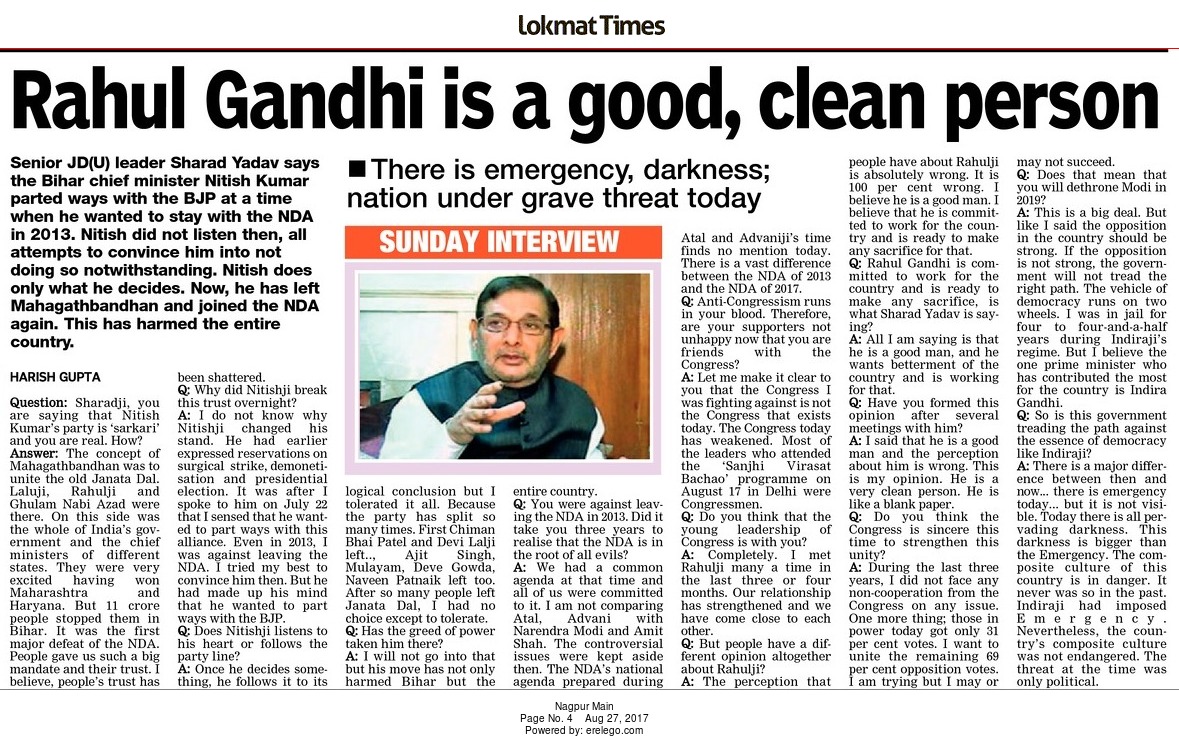
Is Sharad Yadav political adviser to Rahul?

How Rahul Gandhi and the Congress Party changed its stance and agreed to share seats with almost all like-minded parties in Gujrat Assembly polls over-night has surprised party veterans. Talks had broken down with NCP and even the three young musketeers were talking in different tune. An upbeat Congress leadership was unwilling to give peanuts to these new groups. Sonia Gandhi’s key political adviser Ahmad Patel was rushed to AIIMS to undergo emergency heart treatment and things were going haywire. Though he went back in a short span. But it is learnt that something happened and everything was normal. It transpires that Rahul Gandhi had a rather long meeting with Sharad Yadav at his residence. What transpired between the two could be anybody’s guess. But Yadav is an old hand in caste-politics and explained to Rahul Gandhi how the party could never come back to power as it lost crucial caste alliances. The Congress must seize it and its time party should take everybody along. He told Rahul that his objective should be 2019 Lok Sabha polls as once Gujrat is clinched, the dissidents within BJP will grow. Sharad Yadav is also talking to AAP leaders though Congress is firm not to have any truck with it. Yadav wants AAP to field its candidates in such a way that the BJP suffers a set back. 

Why its Waterloo for BJP & Modi

It is no secret that the entire Cabinet has been deployed in poll bound state of Gujrat and the BJP headquarters has been airlifted to Gandhinagar. Amit Shah is claiming that there is nothing new as the BJP always contested polls in states like a war machine. But political pundits say stake are very high in Gujrat compared to any other Assembly poll. Dissidents like Varun Gandhi, Shatrughan Sinha, Kirti Azad, Shyamlal Gupta and a couple of other sitting Lok Sabha MPs  are waiting for the outcome of Gujrat results on December 18. Any adverse outcome may shake the current political fabric and alignments. Though the RSS will continue to bet on Modi despite differences on one issue or the other. But it is aware that Gujrat is the key for 2019 Lok Sabha polls. The BJP has more than 140 Lok Sabha MPs who came from nowhere in the party and given tickets in 2014. Any slide in Gujrat will shake the confidence of these fence sitters. Therefore, the entire focus of the BJP-RSS is to enhancethe BJP’s Gujrat tally of 117 out of 182. The Capital is agog with reports that some of the MPs who have fallen out with the leadership may look around for some political opportunity if there is any slide in BJP’s tally.

Watch out Milind Deora in Congress shake up
  

Milind Deora, former Lok Sabha MP and son of late Murli Deora is set to play a key role in the Team Rahul after he assumes the charge of Congress president. It has been decided that no major shake up will be undertaken in the organisation until the Budget session of Parliament due to pressing circumstances. It will rather be a slow process as immediately after the Gujrat & Himachal Pradesh, Parliament’s Winter session will set in and once the brief session is over, the party will face elections in three states of North East. Then, the Budget session will commence on January end and end early April. Therefore, those eyeing key positions will have to wait for some more time. But Milind Deora is the man to watch.

Tuesday, October 10, 2017

PM won't share dais with Yashwant Sinha

by Harish Gupta, National Editor, Lokmat Group


Organizers in a jam, shadow over centenary function
PM won't share dais with Yashwant Sinha

Harish Gupta

New Delhi, Oct 9
The tussle between the BJP leadership and former Finance Minister Yashwant Sinha has spilled over the centenary celebrations of the Bihar University in Patna. The mega function of the country's most prestigious university is due to take place on October 14 and the Prime Minister, Narendra Modi has accorded his consent to be the chief guest on the occasion.

However, the cloud surfaced when it was learnt that the university authorities had also invited two prominent personalities former Finance Minister Yashwant Sinha and former Shipping Minister and sitting Lok Sabha M P Shatrughan Sinha to be the guest of honour at the function. Reports suggest that the university authorities had invited both of them to share the podium with the PM and other dignitaries. The authorities have invited over 5000 plus alumni to celebrate the 100 years of its inception.

It is now learnt that the Prime Minister Office has made it clear that strict protocol be followed during the visit of the PM Naredra Modi to the Bihar University on the occasion of it centenary celebrations. The instructions have reportedly been issued to the authorities the PM will share the podium with the mandated dignitaries only. The instructions went after it emerged that Yashwant Sinha and Shatrughan Sinha will also share the dais with the Prime Minister and other dignitaries. Health Minister J P Nadda, Food Minister Ram Vilas Sharma, Minister of state for Health Ashiwini Choubey are also among the alumni of the university and have been invited. C P Thakur, a former Union Health Minister and sitting Rajya Sabha MP is also an alumni.

The program had been finalised long before the controversy erupted in the BJP after Yashwant Sinha blasted the economic policies of the government and attacked Finance Minister Arun Jaitley.

Now under the protocol, limited chairs are allowed on the podium with only PM, Governor Satpal Malik, Chief Minister Nitish Kumar, Deputy Chief Minister Sushil Modi, union ministers Ravi Shankar Prasad, J P Nadda, Choubey. It is still not clear whether the two Sinhas will get a place of prominence and where C P Thakur will be be accommodated. The confusion arose as the organisers had while inviting the two Sinhas had requested them to be on the dais as there was no rift between them and the leadership when the invitations were sent months ago.

The organizers of the centenary celebrations are in a big jam as it has been desired that six additional chairs be removed from the main podium. It is said that the Sinhas will be part of the audience now.

end

Thursday, August 24, 2017

Didi may challenge Modi in 2019

by Harish Gupta, National Editor, Lokmat Group


Since Narendra Modi bulldozed the parliament in May 2014, and repeated the feat three years later in Uttar Pradesh, the largest state, the opposition is overwrought with frustration. With the chances of its electoral recovery rather distant, it is unable to paper over the lengthening, and deepening, lines of its internal fissures. Like Bihar chief minister Nitish Kumar’s exit from its camp; his JD(U) facing an existential crisis; or the CPI(M), which is convulsing with internal dissensions so deep that its general secretary Sitaram Yechury fails to get his party’s nod for returning to the Rajya Sabha with Congress support.

The opposition is hamstrung for other reasons too. Faced with BJP, RSS and their ideological challenge, the traditional ‘secular’ politician seems to have lost the plot. His response to incidents of serious cultural onslaught is feeble, at best. For example, no opposition party has worked out a coherent strategy to combat the Hindutva groups nursing their private militia in the name of cow vigilantes. They attack cow vigilantism as though it were the handiwork of extreme bigots sheltered by the Hindutva groups. But they have failed to present it as an integral part of an agenda to turn the religious minorities into second class citizens. Their bankruptcy surfaced when Congress workers attacked a BJP leader in Chhattisgarh responsible for cows death. On the rare occasions that Congress president Sonia Gandhi, or Rahul Gandhi, the vice president, comment on contemporary issues, they fail to strike a chord. While Rahul shoots and scoots, his mother has limited grasp of India’s social and civilizational issues. BSP supremo Mayawati, always shy to venture beyond Dalit issues has become even more tongue-tied. Down south in Tamil Nadu, ruling AIADMK and two other factions are getting sucked into the BJP rather than trying to redefine themselves in India’s political landscape after the end of multi-party rule. In Maharashtra, so total is the hold of BJP that Shiv Sena, its ideological sibling and local rival for power, outshines other opposition parties. In the states where the Congress is ensconced, such as Karnataka, there is not much certainty about its continuance.

In such bleak scenario for the opposition, two things are missing—leadership and strategy. Some of the opposition parties assumed that, in fighting BJP, the best strategy would be to forget past differences with the Congress and tie up with it. In Uttar Pradesh, former chief minister Akhilesh Yadav tried it, and paid heavily for that mistake. In West Bengal, the CPI(M), by fighting the 2016 assembly election jointly with the Congress, fell into the same trap.

With the passing of years, if there is a single opposition leader to cobble up a strategy against BJP’s divisive politics, she is Mamata Banerjee. The West Bengal chief minister is a master player of the caste and sub-caste cards. In 2011, she succeeded in putting the 34-year-old CPI(M) rule to an end my mobilising the subalterns against a party which, though highly regimented, had only higher castes in its upper echelons.

Her Bengal is in BJP’s crosshairs for a long time. During CPI(M) rule, there was no entry for the Hindutva politics as the state’s poor were entirely identified with the hammer-and-sickle. BJP thought that, following the Marxists’ exit, it may be able to polarize votes.

But the BJP’s strategy against Mamata Banerjee has not succeeded so far. It brought limited dividend in 2014 with BJP getting 16 per cent votes (only two seats). But the BJP share came down to 10 per cent in the assembly elections two years later. Banerjee ruled the roost as her deft ‘salami slicing’ of the state’s huge OBC and dalit population did not allow the BJP to herd all non-Hindus under the saffron shamiana. It is a strategy that has worked.

In India, with ‘forward caste’ population estimated to be around 25 per cent (that leaves three-quarters of the population comprising the entire panoply of OBC and dalit, plus minorities), it is tough for BJP, to win elections without support from a large section of non-caste Hindus. That explains why Modi, and party president Amit Shah, have been reaching out to those on the lower rungs of the caste ladder, with a Dalit being made the President of India. Ram Vilas Paswan, a Dalit, heads the LJSP, an important partner in the ruling NDA. During his tours aimed at the 2019 general election, Shah makes it a point to have lunch (well publicised) one day in a dalit home.

In India’s social fabric of mixed hue, it is not possible to win elections on the support of one or two castes. Mayawati, for example, won elections in Uttar Pradesh whenever she could broaden her appeal beyond the jatav community of dalits to which she belongs. But Mamata Banerjee’s appeal is subtler. It works on the ‘class animosity’ among castes, thus posing a challenge to the BJP strategy of appealing to an all-embracing Hindu identity. Last year, as there were minor skirmishes between Hindus and Muslims at Dhulagarh in Howrah district, BJP bent over backwards to give it a communal tinge but the Trinamool leader used a mix of her understanding of subaltern politics, and executive power, to deny BJP any leeway.

The answer to religious identity politics is the politics of subaltern identity. Nitish Kumar realised it as he introduced the mahadalit concept and re-embraced Lalu Yadav. But he has hung up his boots in opposition politics. In today’s scenario, if Modi’s BJP can face a serious contender in 2019, it has to be from Mamata Banerjee.

Thursday, June 15, 2017

BJP Presidential nominee by June 21

by Harish Gupta, National Editor, Lokmat Group


Special Report 

Presidential candidate

BJP presidential nominee by June 21

Amit Shah meets Naidu & others

3-member ministerial panel working in full swing

Harish Gupta

New Delhi, June 13

The three member ministerial group to hold consultations with the allies and the Opposition parties for the selection of the Presidential candidate held its first meeting this morning.

The meeting was held at the residence of  Urban Development and I&B Minister M Venkiah Nadu, Finance Minister Arun Jaitley and Home Minister Rajnath Singh. Interestingly, the BJP president Amit Shah was also present at the meeting.

It is learnt that the name of the BJP’s presidential candidate will be finalized early next week and all consultation process with allies and Opposition parties will be completed by then. An elaborate plan was discussed today to finalise the roadmap, from selection to filing nomination papers, for the party’s Presidential candidate before June 21-22. 

It was somewhat an irony that Venkiah Naidu who was in the reckoning for the President’s post, has been made a member of the selection committee itself.

According to informed sources, the top leaders met to evolve a strategy as who will speak to which party and which groups. While Arun Jaitley will talk to leaders of Opposition parties in the Rajya Sabha since he has a very high level of personal relationship with them. He has a great rapport with Bihar Chief Minister Nitish Kumar, Derek Obrian of TMC, Ram Gopal Yadav (Samajwadi Party), Satish Mishra (BSP), Praful Patel (NCP) and others. He has high level of comfortable relations with Anand Sharma (Congress) and deputy chairman P J Kurien. Amongst the allies, he is close to the Akali Dal leadership and a large number of Independents and smaller parties.

Venkiah Naidu has primarily been charge of talking to all political parties of southern India including Pudducherry and Chief Ministers of various states. The TDP, TRS, various factions of the AIADMK, Janata Dal (S), Rajnath Singh will handle Jammu & Kashmir and North Eastern State Parties and chief ministers.

The task is not only to focus on the Members of Parliament of Lok Sabha & Rajya Sabha but also MLAs who will count in a big way. There is a whole battery of smaller parties in states and Independents.

The objective is to talk to all these MPs, MLAs and parties to obtain their in-principle support for the BJP nominee and thereafter talk to the Opposition parties.

As per plan, the ruling NDA will complete the process this week end and thereafter the process of consultations with the Opposition will begin.


The last date for filing nominations is June 28.

Meanwhile, the government constituted  a committee of secretaries headed by Cabinet Secretary P K Sinha to oversee arrangements for the swearing-in-ceremony of the new president on July 25.

Ends 

Wednesday, June 7, 2017

Opposition needs French lesson

by Harish Gupta, National Editor, Lokmat Group


The routing of the opposition in the Uttar Pradesh assembly elections by the BJP under Prime Minister Narendra Modi had a stunning effect which will not subside anytime soon.

The initiative that Congress president Sonia Gandhi began since April to meet individual opposition leaders—from Sharad Pawar to CPM’s Sitaram Yechuri, both Nitish Kumar and Lalu Yadav of Bihar, or West Bengal chief minister Mamata Banerjee—is a direct fallout of the defeat in Uttar Pradesh.

However, it is the seemingly irresistible rise of BJP, and the anxiety that it may after all change the rules of the game of politics set in the past decades, that has spread across the length and breadth of the country. In Chennai, the possibility of matinee idol Rajanikanth carrying the flag of BJP into peninsular India has made the Opposition worried. It lent  to the birthday of nonagenarian leader K. Karunanidhi, into a matter of national urgency, on the scale of Udyog Parvin the Mahabharata. In Uttar Pradesh, Samajwadi Party leader and former chief minister Akhilesh Yadav has resumed calling BSP supremo and his sworn enemy Mayawati “bua” and they are talking again directly now. Besides, unfazed by the new anti-corruption inquiries he is facing, Lalu Yadav is holding a joint rally of opposition parties in Patna on August 27, its battle cry being “BJP hatao, desh bachao”.

Nevertheless, achieving opposition unity is easier said than done. It’s because it was hopelessly disunited to begin with, so much so that the BJP could manage to come to power in 2014 due to, inter alia, its disunity. The vote share of NDA was 38 per cent yet it bagged 336 (61.87%) of the 543 Lok Sabha seats.

And now, after the UPA parties’ misfortune, their internal problems have compounded. Mayawati is no longer the monarch of her Jatav community as the Dalit youths of Saharanpur in Uttar Pradesh, have taken their destiny in their own hands instead of leaving it to BSP. They were oppressed by the rich and armed and politically influential Rajputs. Now they have formed Bhim Sena which promises to become the community’s new platform. Within SP, the Yadav family tussle involving  Akhilesh and Mulayam Singh Yadav, his father and the party’s founder, is far from being resolved. Also doubtful is the Congress’ ability to project itself any longer as the ‘natural cradle’ of potential prime ministers. Sonia Gandhi’s ‘unity luncheon’ (for selecting opposition candidate for President election), coinciding with the NDA government’s third anniversary, skipped by Bihar chief minister Nitish Kumar, was an impressive photo-op, and just about that.

In fact, Nitish rubbed it in by abstaining from Sonia’s conclave yet meeting the Prime Minister over lunch the very next day. Pawar was present at the lunch but he’d earlier turned down Sonia’s call-in to be UPA’s presidential candidate. “The job comes with a great house but I enjoy talking to you”, he later told journalists. Obviously, the job he’s aspiring to is to lead the next government from Parliament, not Rashtrapati Bhavan. Nitish Kumar, too, has got his sight set on the prime minister’s job. In his earlier meeting with Sonia, he’d recommended a second term for Pranab Mukherjee, the outgoing President. However, he said little about the nature and leadership of a future opposition alliance. The Congress is desperately looking for an alliance with H D Deve Gowda in Karnataka. But Gowda is deeply hurt as the Congress government had put his son H D Kumaraswamy in jail. He did attend Sonia’s lunch after persuaded by Sharad Yadav and Sitaram Yechuri. But no further political deal in Karnataka.

The opposition turf has no shortage of vaulting ambition, inflated ego, or pulses racing doe to Modi’s taxmen and cops closing in on piles of allegedly ill-gotten cash. But that doesn’t a leader make. The big change that has hit the electoral process in democracies worldwide is that it has become almost entirely personality oriented, like in the presidential system, with little room for the opposition except that of “also ran”. Most recently, it has happened in France, with centrist and globalist Emmanuel Macron getting  66 per cent votes while Marine Le Pen, the right-wing populist being left with only 34 per cent. What’s noteworthy is that Macron, who had been the finance minister in the previous socialist government of Francoise Hollande (something comparable in its ineptitude and venality to the Manmohan Singh-led UPA-2), quit it, formed his fledgling party En Marche, and targeted and grabbed his bull’s-eye—the huge middle ground that’d shiver to support Hollande’s  party yet would have voted for Le Pen if there was no option.

Incidentally, Britain is heading for a similar situation as it goes to poll on Thursday, June 8. In this mid-term poll, the British voter will be caught between prime minister Theresa May’s pro-Brexit Conservative Party and the Labour under the leadership of Jeremy Corbyn, a rather loopy communist who worships Venezuelan ex-president the late Hugo Chavez and says if elected PM he’d nationalize mail, rail and energy firms. That’s a bit too much in a nation that still respects Margaret Thatcher, the ‘iron lady’ of privatization, and the country reshaped by her. The country became the bedrock on which two ‘new Labour’ PMs, Tony Blair and Gordon Brown, could thrive. Corbyn is a hater of their ‘neo-liberalism’ while May is clearly devoid of political ideas. Therefore, it is likely that, come June 8, voters will move one way in large herds but none will be there to represent the sensible middle ground. Significantly, Macron polled 84 per cent of the top 20 per cent highest educated voters.


India did not (and does not) have a Macron-type leader primarily because it lacks enlightened voters. But that is no excuse for leaders being so bereft of ideas about the direction that India may follow. When called upon to govern states, their ideas are limited to banning alcohol, or denying land to industry. It’s not Modi’s opposition, India is waiting for his challenger.

Wednesday, May 24, 2017

"A" in politics but low in Economics

by Harish Gupta, National Editor, Lokmat Group


In democracy, completion of three years in power is a time for perturbation as that’s when the curse of “anti-incumbency” sets in.

Prime Minister Narendra Modi is an exception. Into his fourth year in power, there is hardly any popular disgruntlement against his incumbency. It was evident in the assembly election in Uttar Pradesh last March when the BJP under Modi and party president Amit Shah succeeded in pulverising the ruling Samajwadi Party much to the same extent to which the saffron party had steamrolled its rivals in the mega-state in the 2014 general elections.

By now, BJP is armed with an election machinery which is unparalleled. Its leadership’s ardour to win every poll is legendary. And for the party, the importance of the year 2019, when Modi’s second innings in power is expected to begin, is underlined. At least this is the impression one gets after talking to a number of Opposition leaders. Bihar Chief Minister Nitish Kumar’s statement that he is not in the race for the Prime Minister’s post and veteran politician Sharad Pawar is not ready to play ball with the Congress clearly give the impression that they are unwilling to fight with Modi.  

It is obvious that BJP is shining in the absence of competition. Congress president Sonia Gandhi, Trinamool chief Mamata Banerjee, CPI(M)’s Sitaram Yechuri—all of them seem trapped in a single strategic silo to combat Modi, which is to “unite” the opposition. The Presidential poll, due in July, can be the first test of unity. But that’s most likely to be fighting a losing battle, as there are unbridgeable fissures in the opposition—Mamata Vs CPM, AAP’s Kejriwal Vs Congress, Samajwadi Party Vs BSP’s Mayawati. Beside, Modi’s inclusive style of campaigning has gravely challenged the traditional parties’ vote-banks. Mayawati’s Jatav, Mulayam Singh Yadav’s once famous Muslim (M)-Yadav (Y) amalgam, Delhi’s Bihari immigrant voters loyal to AAP—recent elections show that the lure of Modi’s “mitron” call brought about seemingly irreparable cracks in these traditional alliances.

Besides, the opposition is bereft of tall leaders. Unlike its UPA predecessor, the Modi administration is not protective about politicians involved in graft cases. Instead, its in-the-face attitude has dragooned most opposition stalwarts in cases from which escape is not guaranteed. Like Laloo and his family members in money-laundering charges; Congress former Home and Finance Minister P. Chidambaram and his son, Karti, in the allegation of siphoning off huge amounts to acquire, among other things, large property in Britain; most of Mamata’s ministers and party leaders waiting to be picked up by CBI on the charge of accepting bribe as shown in the ‘Narada’ sting operation. In the National Herald illegal share-transfer case, the noose may also tighten on Sonia Gandhi and her son, Rahul, the Congress vice-president.

The opposition calls it “witch hunt” but its voice is feeble, with the media prone to self-censorship, and the government, armed with summary provision under Sec 124A of the IPC, being empowered to swoop down on its critics in the social media on the charge of being ‘seditious’. Besides, hit by a blizzard of serious corruption charges, the opposition seems to have lost its moral heft to stand up and question the government. It is more serious than comparable global developments, like near-evaporation of the Labour Party in UK, or the US Democratic Party being in eclipse. Unlike these mature democracies, the Indian opposition parties are personality-based and not much remains of them when the central towering figure collapses.

Though Modi’s political victory so far is undeniable, there are signs of weariness in governance and vision. In 2014, he promised: “I will make such a wonderful India that all Americans will stand in line to get a visa for India”. Unfortunately, things have moved in a different direction. Somewhat embarrassingly, the government Central Statistics Office’s (CSO) figures of national income refuse to tally with estimates of industrial production. In the quarter covering demonetisation of large notes last November, the index of industrial production was flat but national income grew at 7%, like in magic. With large malls lying near-empty, or being converted to office space, a shortfall in demand is self-evident.

Behind decline in demand is the stark reality of job opportunities shrinking. It is not merely due to Donald Trump’s visa policy, or problems in the IT sector due to shifts in technology (entry of robots in workplaces, for example). There are other reasons too, such as:

·      India has 10 million new workers to the workforce annually, but available non-agricultural jobs are less than 5 per cent;

·      Poor education system has rendered most Indians unemployable, including 90 % of the 10 lakh engineers passing out every year;

·      China became the world’s factory in the 1980’s. Now protectionism rules the roost, with global trade remaining subdued at 2.7% in volume terms. India may not be able to do the China act.

·      CRISIL estimates 12 million people will join agricultural workforce between 2011-12 and 2018-19. But agri workers’ number is declining very fast. So the country cannot move up the value chain to become a modern nation.

·      Agriculture, construction, manufacturing—sectors that employ people are lagging GDP growth. Though agriculture production has shown improvement. But its after two years’ of consecutive drought. What have outpaced GDP growth are financial services, real estate, public administration, and trade, hotels and restaurants. Except the last, all other growing sectors have little job potential. The country is indeed experiencing jobless growth. In the proposed GST regime, the last two have been hit hard.

From the rough and tumble of electoral politics, can Modi take a creative leap to make India a hub of innovation and growth? In the next two years, he must prove he can think big on governance. Or else the queues in India for American visa will continue to be longer than the other way round.


Monday, April 24, 2017

NCP may join Congress-led Front Sharad Pawar to be its Convener

by Harish Gupta, National Editor, Lokmat Group


Exclusive report 


NCP may join Congress-led Front Sharad Pawar to be its Convener

Nitish, Yechury, Gowda, Mamata agree
  
Harish Gupta
New Delhi, April 21

The Nationalist Congress Party (NCP) is seriously considering a proposal to join a front of like-minded Opposition parties. The NCP which quit the United Progressive Alliance (UPA) three years ago, is being wooed by the Congress, CPM and the Janata Dal leadership to play a pivotal role in this hour of crisis and strengthen Opposition parties.

According to indications available here one of the suggestions doing the rounds is that instead of the United Progressive Alliance (UPA), a new joint front be formed of like-minded secular parties. This front should be formed early so that enough time is available to put up a credible challenge to the BJP before 2019 Lok Sabha polls.

It is also suggested that  Sharad Pawar be made Convener of this Joint front. Of course, Sonia Gandhi will be named chairperson of this new outfit and Nitish Kumar will also hold a key position in this proposed outfit.

If reports are to be believed, Sonia Gandhi is keen that Sharad Pawar play pivotal role in bringing all Opposition parties together as he has the capability to do so. Though some senior Congress Party leaders were trying to put a spanner in the move. But Sonia Gandhi snubbed them saying that the country was facing a grave crisis and unity of the Opposition parties is needed.

When asked Praful Patel told Lokmat, “ We are talking and various proposals are over the table. I have nothing more to say on the issue as of now. Let’s see”

Sitaram Yechury was also guarded in his comments and said, “ we are working to bring all like-minded forces together.”

However, the NCP leaders told categorically that Opposition unity should not be one-shot affair (for President’s polls). But it has to be with a long term perspective and unity should be with open mind and heart. Obviously, the NCP leadership is hurt that the Gandhis never trusted Pawar.

However, times have changed and it was Congress vice President Rahul Gandhi who had taken the first initiative in March itself when he drove down to the residence of Sharad Pawar signaling that a “thaw” is possible after the two parties parted company three years ago. Later, CPM general secretary Sitaram Yechury held a meeting with Pawar and Praful Patel.

Bihar Chief Minister Nitish Kumar who met Sonia Gandhi yesterday, emphasized the creation of a new front. West Bengal Chief Minister Mamata Banerjee, CPI leader D Raja and others have met Sonia Gandhi recently. Mamata Banerjee flew down to Bhuvneshwar to meet the Odisha Chief Minister Naveen Patnaik to explore possibility to have a working relationship to strengthen the Opposition because Congress is the principal Opposition party in the state. Janata Dal (U) general secretary K C Tyagi is going to Bengaluru to meet Janata Dal (S) leader H D Deve Gowda on Saturday.

Wednesday, April 12, 2017

Prez Polls: Oppn may field Sharad Yadav

by Harish Gupta, National Editor, Lokmat Group

Exclusive  News Report 

President’s poll :  Opposition may field Sharad Yadav as its candidate
  
Harish Gupta

New Delhi, April 11

With the BJP mobilizing its 33 allies to get its own Presidential candidate elected in the polls slated for July this year, the Opposition parties have also geared up to field a “common candidate” against the BJP nominee.
  
Janata Dal (U) leader Sharad Yadav’s name has emerged as a consensus candidate for the President’s post. Highly placed sources say that a preliminary discussion has already been held in this regard between Congress vice president Rahul Gandhi and CPM general secretary Sitaram Yechury. Both leaders felt that the Opposition parties should together field a candidate for the President’s post where the BJP is still short of a majority. It was also stressed that if most of the small & regional parties like TMC, Biju Janata Dal, TRS, YSR (Congress), JD (S), JMM, DMK & AIADMK and others come together,  the Opposition candidate can emerge victorious. It was Bihar Chief Minister Nitish Kumar who first spoke to Sitaram Yechury in this regard and he held informal talks with the Samajwadi Party leader Mulayam Singh Yadav and then met Rahul Gandhi. The RJD leader, Lalu Prasad Yadav is also supportive of the idea of putting up a joint candidate.

Though Sharad Yadav’s name has not been finalized as yet. But considering the prevailing political situation in the country, a candidate has to be either from backward or scheduled caste or scheduled tribe community. Though the Congress Party was initially of the opinion that Vice President Dr Hamid Ansari be put up for the post of President as a joint Opposition candidate. But it was felt that the candidate should be outside the Congress Party if Opposition unity is to be achieved.

The NCP leaders have also been sounded in this regard and they have shown their inclination to support Sharad Yadav for the post. The Opposition parties are aware that the BJP and Prime Minister Narendra Modi are have already roped in 33 political parties across the country in the NDA and expanding their base. The NDA already has 48% of the popular votes in its kitty and its candidate will make it to the post unless all the remaining parties join hands in supporting the common Opposition candidate.

But one thing is clear; the Congress & opposition parties won’t allow the BJP to get its candidate without a contest. “We will give BJP run for its money in the presidential poll,” said a senior Opposition leader familiar with political developments.

Wednesday, February 1, 2017

Never a vote-less Year

by Harish Gupta, National Editor, Lokmat Group


India is a nation with its carnival of elections. The Lok Sabha election is a colossal affair that involves a population nearly a seventh of humanity. Yet it does not speak the last word even for a year or two. In 2014, the consummate victory of BJP under Narendra Modi kept doubts and disgruntlement on a low key. But that was only for a while. The very next year, in the city state of Delhi, the fiercely anti-BJP Aam Aadmi Party (AAP) swept the 70-member assembly, grabbing 67 and leaving only three seats for BJP. The BJP succeeded in grabbing Haryana, Jharkhand and Maharashtra (with Shiv Sena help). But after a few months, in the crucial state of Bihar, it was repeated. RJD chief Lalu Yadav and incumbent chief minister Nitish Kumar, sworn enemies over a decade, made friends; their alliance trounced BJP. All this led to an unprecedented national mood-swing to the detriment of Modi, holding up his reform plans and denting his authority. Is it good for democracy, or not? 

One argument is that the division of power in a democracy is all about checks and balances, and, being so, it is perhaps good for the nation to keep the party in power accountable throughout its tenure, with the series of assembly elections being a way of keeping it on the edge. On the flip side, though, it invites too much discordance for the Central government to carry out its mandate, leading ultimately to ‘policy paralysis’, the malady that plagued the previous UPA-II government. Democracy, like the judicial system, is certainly adversarial at its core. But for a government to perform it needs consensus, which an unending procession of elections can disrupt. 


This February-March, there will be elections, not only in the mega-state of Uttar Pradesh but in six more, including Punjab and later this year in Gujarat. 

The 2018 calendar too is ‘eventful’, with elections due in Congress-ruled Karnataka and the BJP-ruled Chattisgarh, Madhya Pradesh and Rajasthan. Even in 2019, when the next general election is due, as many as eight states, including key states like Maharashtra, Andhra Pradesh and Telangana, will have their assemblies re-elected. There is no guarantee that all the elections will be synchronous. The cycle of elections got disrupted in the late Sixties, with the rise of anti-Congress parties across north India leading to dissolutions of legislative houses at the Centre and states. It is now like a clock that has its movements gone haywire. They must be reassembled if the clock has to tick on. 

Efforts towards it are in progress, though there is no consensus in sight. The government now seems willing to go by the decision of the parliamentary Standing Committee on Personnel, Public Grievances, Law and Justice, headed by Dr. E. M. Sudarsana Nachiappan (Congress), which has made the following recommendation: that elections be held in two phases, first, that of some legislative assemblies bunched together around the mid-term of the Lok Sabha, and the rest of the assemblies going to poll at the end of the Lok Sabha’s term. The idea is to club together all state assemblies going to poll in a span of six months to one year. If, for instance, such a law were already in place, Delhi, Haryana, Jharkhand and Maharashtra would have gone to poll in sync with 2014 general election, and Bihar, Uttar Pradesh, Bengal, Punjab, Tamil Nadu. Puducherry etc. were to hold elections on a fixed date (or dates) this year. 

It also implies that a good many states in which polls are due in 2018 must wait for up to a year if their elections are to synchronise with 2019 general election. On the other hand, to make elections simultaneous, it may be necessary to shift the timing of Lok Sabha elections too. 

All this require amendment to Article 83(2) providing for a term of five years for the House of the People, and Article 172(1) providing for a five-year tenure for the legislative assemblies from the dates of their first sitting. The Committee has recommended that in order to hold early elections to Lok Sabha and state legislative assemblies, one of the two conditions must be met: (a) a motion for an early general election must be passed by the House, or (b) a no-confidence motion must be passed by the House, with no alternative government being passed, with no alternative government being elected within 14 days. Dr. Nachiappan’s party, Congress, is not in favour of the changes on the ground that these are “impractical, unworkable and can lead to a scenario where the necessary balance in the Indian democracy given the diversity of the country is lost”. Now the Congress has suggested that there should be a Constitutional amendment bill if Modi wants his wish to be implemented.

The liberal camp views the move with apprehension. It smells a political motive. It is generally believed that when elections are held together voters act similarly. Popular wisdom, though, is that Indian voters are “astute” enough to distinguish between voting for government at the state level and that at the Centre. But IDFC Institute, a Mumbai-based think tank, has, in a research paper, has established, based on data since 1999 elections, that there is 77 per cent probability of an Indian voters preferring the same party at the Centre and state if elections are held simultaneously. So there may not be much evidence in support of our voter’s fabled “astuteness”. 

Interestingly, the Election Commission of India and President Pranab Mukherjee have also come forward to support the government desire to hold simultaneous polls.


But the core problem for Modi is to persuade the non-Congress opposition to come on board. Modi succeeded in getting all including Congress together on the GST issue as it was to benefit all. But the opposition suspects simultaneous poll to be a ruse to shrink the space for making up in the subsequent innings.