by Harish Gupta, National Editor, Lokmat Group
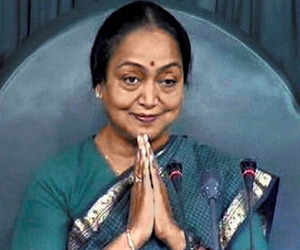
In this space last week, I doubted if the secret ballot system in the presidential and vice-presidential elections could be entirely to the advantage of the BJP-led NDA. The opposition looked like having an ace up its sleeve as its candidate for Presidency, Meira Kumar, was bubbling over for what she thought could be “vote according to conscience”.
It wasn’t. Cross-voting had benefited not Kumar but Ram Nath Kovind, BJP’s victorious candidate. In Gujarat, as a prelude, perhaps, to former chief minister Shankar Sinh Baghela quitting the Congress, at least 11 Congress MLAs ditched Kumar to vote Kovind. In West Bengal, Kovind bagged the votes of 11 MLAs though BJP and its allies could have openly garnered only six MLAs. But its largely some dissidence in Congress & the Left that may have gone in favour of Kovind. Mamata devised a mechanism through which she ensured that there is no cross voting in her party except one MP who is suspended. In Maharashtra, Meira Kumar’s tally was 77, which fell short of her calculation by at least ten. In Uttar Pradesh, eight MLAs had violated their party instructions by voting Kovind; they could be ‘renegades’ from the Akhilesh Singh Yadav-faction of the Samajwadi Party. The numbers in the tiny north-eastern state of Tripura are baffling; in a state with no BJP legislator, Kovind found seven silent supporters. There were opposition reversals in Punjab too, as two of the Aam Aadmi Party’s four MPs are suspected to have for the BJP candidate.
There was a reverse trend as well. In Rajasthan, Meira Kumar was supported by ten more MLAs than her expected tally, a feat which is not possible without some BJP MLAs having been driven by the ‘call of conscience’. But volume-wise, the trend of cross-voting was overwhelmingly dominated by the BJP. Like Kumar, Gopal Gandhi, Opposition’s Vice Presidential candidate, too has pinned his hope on the electors’ “conscience”.
The failure of the appeal to ‘good sense’ is not a recent phenomenon. In the years between Independence and promulgation of the Constitution in 1950, the so-called idea of India got delineated in the very preamble of the Constitution. It was made on behalf of the “people of India”, which is, by itself, an assertion that the country would make no discrimination on the ground of caste, creed, gender or religion. The preamble defined the Constitution’s four pillars: justice, liberty, equality and fraternity. B. R. Ambedkar, the acknowledged architect of the Constitution, said on the last day’s session of the Constituent Assembly on November 25, 1949: “Political democracy cannot last unless there is at the base of it social democracy. What does social democracy mean? It means a way of life which recognises liberty, equality and fraternity as the principles of life”. Ambedkar had also said that these three principles of liberty, equality and fraternity were “not to be treated as separate items in a trinity” because (a) equality without liberty would kill individual initiative, (b) without equality, liberty would produce the supremacy of the few over the many, and (c) without fraternity, liberty and equality could not become a natural course of things…it would require a constable to enforce them”.
I have cited this long passage from one of the most sparkling discourses in Indian politics because it provides, in a sense, the essence of the “conscience” or “good sense” that UPA, the loser, has vainly tried to invoke. Such ideal is embedded in the Constitution and is made explicit in Ambedkar’s radiant prose. As the first to form government, it was the Congress’ turn to follow the principles laid down in the Constitution. But it failed and failed the people of India.
It was during the Congress rule that equality got divorced from liberty by a bizarre quality of government and its myriad rules and regulations. It snuffed out “individual initiative”, exactly as Ambedkar had predicted. Again, it was in the Congress rule that equality of opportunity was denied to the poor while the rich had the liberty to influence policy and get richer. Another Ambedkar prophesy that came true.
However, the absence of fraternity has a long history. The communal holocaust and partition in 1947 itself is a testimony to the dismal fact that the Indian society was revelling in fratricide instead of being fraternal. Nor was the Congress any less divisive than what it accuses Modi of, in its handling of caste and communal issues. From the 1980’s, when infusion of militancy turned Islam into a security threat, successive Congress or Congress-led governments had, instead of promoting fraternity, tried to put the communities into their separate silos. In the Shah Bano case, by refusing to reform the obsolete Muslim marital system, Congress PM Rajiv Gandhi pushed the community back into its medieval isolation. A fraternal approach would have been to help the community to reform itself. On the other hand, the Rajiv administration, by allowing a Hindu group to perform worship of Ram in the Babri mosque, virtually ignited the communal fire which is still blazing. Equality and fraternity became victims of decades of vote-bank politics.
The problem with Congress’ recent and vociferous appeal to people’s conscience is that most people—the new generation, in particular—do not think of BJP’s adversaries as repositories of conscience. Instead, they are seen by the younger Indians as a picture of ineptitude and corruption. Its the loss of credibility on policy and conduct. It is not that the Congress doesn’t understand it, but it has few options. If it must keep its own conscience clear, it has to snap ties with Lalu Yadav. With that vanishes its toehold on power in Hindi-speaking India.
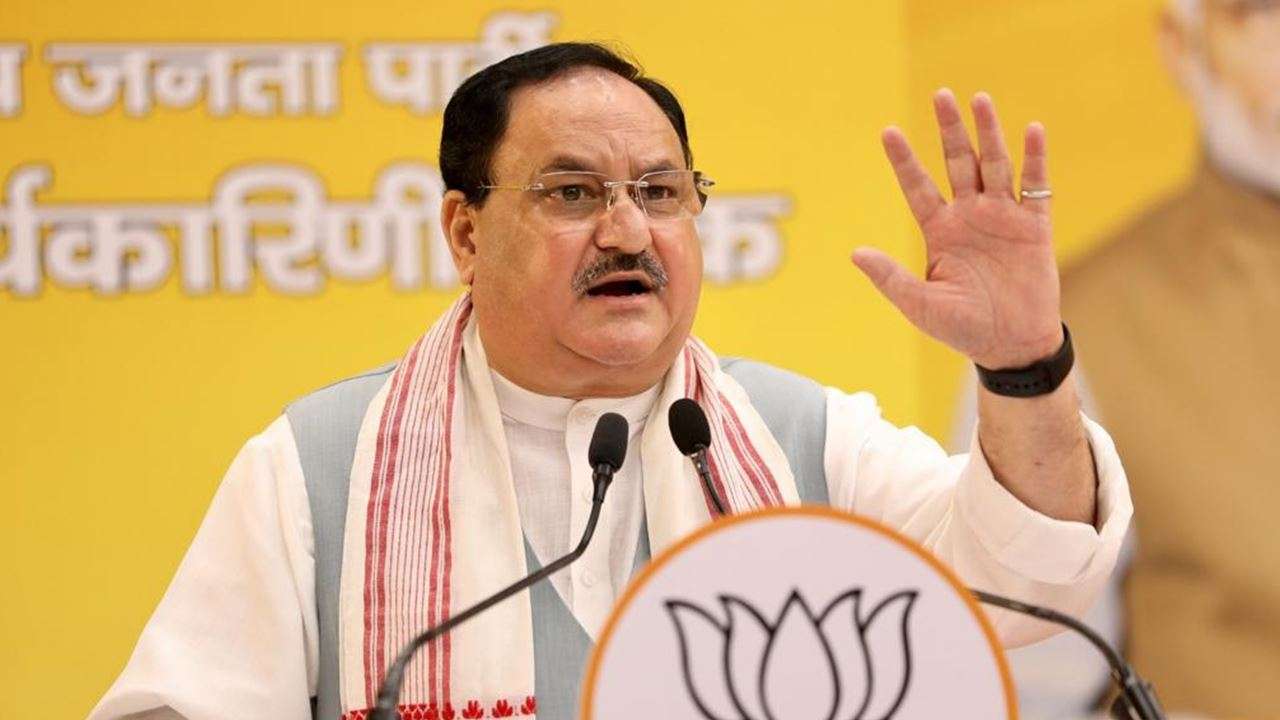 Something unprecedented happened when the PM visited BJP headquarters for a “thanks giving” function to Bihar voters after its rare win. The BJP emerged as a “big brother” to Nitish Kumar after two decades and it was no mean achievement. The Bihar polls were a turning point for the party’s fortunes in elections due next year. Addressing workers, the PM suddenly turned to Nadda and said, “Nadda ji aap aage chalo hum tumahare saath hain” (Nadda ji, you lead it from the front and we are with you). Heads turned as such right-handed compliments were never given to any of Nadda’s predecessors by Modi in the past. When Modi repeated the compliment, Nadda got up from his seat to thank Modi. When Modi repeated the Nadda slogan a third time, Amit Shah, Rajnath Singh, Nitin Gadkari and others got up and clapped for Nadda rather sheepishly. Was Modi sending a message to leaders who did not go for campaigning in Bihar anticipating a defeat. The rare compliment sent Nadda on 7th Heaven as he single-handedly remained stationed in Bihar earning a feather in the cap. Is he coming out of the shadow of his seniors? One will have to watch out. But he has made his mark.